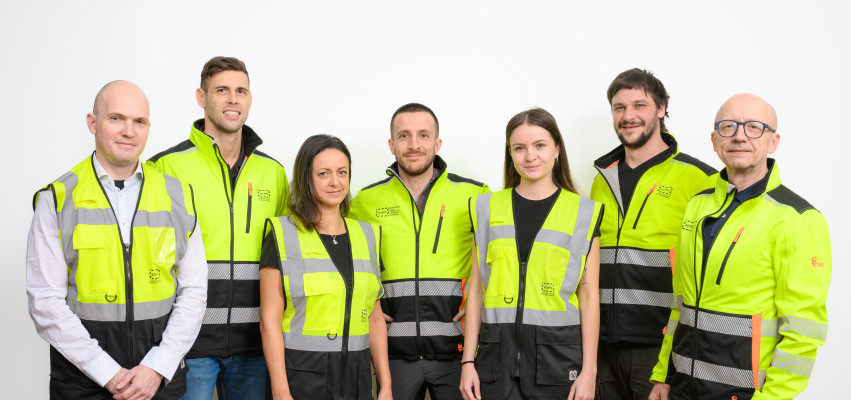
Workplace safety for a construction company
On a construction site nothing can be left for later. Most fatal accidents at work in Slovakia come from falls from height and from work that somebody started without anyone coordinating it. Here is what a construction company must have sorted before the first excavation.
What you need from your first employee
- initial OSH training and refresher training at least every three years (Section 7(1) and (5) of Act No. 124/2006 Coll.),
- a written risk assessment document and a list of PPE provided (Section 6(1)(c) and (d) of Act No. 124/2006 Coll.),
- occupational health service and work categorisation (Section 21(3) of Act No. 124/2006 Coll.),
- fire protection training and fire protection documentation (Section 22 of Decree No. 121/2002 Coll., Section 9(2) of Act No. 314/2001 Coll.),
- records and reporting of occupational accidents under Section 17 of Act No. 124/2006 Coll.
Safety coordinator and the OSH plan
Government Regulation No. 396/2006 Coll. on minimum safety and health requirements for construction sites covers situations where more than one employer works on the site. The client is then obliged to appoint a documentation coordinator and a safety coordinator and to have a health and safety plan drawn up. The plan must be ready before work starts and kept up to date, not written after an inspection. The regulation also sets out when a site has to be notified to the Labour Inspectorate.
If you are not sure whether you need a coordinator, send us the scope of the project and the number of contractors and we will assess it for you.
Work at height
Work at height and above open depth is covered by Government Regulation No. 147/2013 Coll. In practice you need a risk assessment of the specific activity at height rather than a general sentence in the documentation, collective protection (guard rails, safety nets) in preference to personal protection, designated anchor points, a harness, a fall arrester and a rescue plan where personal protection is used, inspections and tests of the personal fall protection equipment within the manufacturer's intervals, and training of workers for work at height and for the specific system. Scaffolding may only be erected, altered and dismantled by persons with the relevant professional competence and with a handover record.
Machinery, lifting equipment and certificates
Operating construction machinery, cranes, lifting platforms and powered trucks requires a certificate of professional competence (Section 16 of Act No. 124/2006 Coll.). Lifting equipment is dedicated technical equipment under Decree No. 508/2009 Coll. and is subject to professional inspections and tests (Section 13) and to operation by a certified person (Section 17). Slingers need their own competence.
Electricity on site
Distribution boards, extension leads and hand-held power tools on a site are in the worst possible environment: damp, dust, mechanical damage. Inspections and tests of electrical appliances follow STN 33 1630:2025, which replaced STN 33 1600 and STN 33 1610 on 1 May 2025, with parallel use until 1 May 2027. The site's electrical installation is dedicated technical equipment under Decree No. 508/2009 Coll.
Noise and manual handling
Breakers, saws and grinders exceed the noise action values under Government Regulation No. 115/2006 Coll.: lower action value 80 dB, upper 85 dB, limit value 87 dB for eight-hour exposure. Manual handling of materials falls under Government Regulation No. 281/2006 Coll.
Fire protection on site
Welding, cutting and the use of open flames are activities with an increased risk of fire under Section 1(1) of Decree No. 121/2002 Coll. You need a permit, a fire watch and a check of the site after the work ends, plus portable fire extinguishers, marking under Government Regulation No. 387/2006 Coll. and order on the site.
Ask for a quotation for your project, tell us the type of construction, the number of employees and how many contractors work on it.
-
How to avoid fines for OSH, fire protection and oc...
OSH fines up to €100,000, fire protection up to €16,596, occup...
-

Workplace safety for a hotel and guest house
What a hotel needs: evacuation plan and fire alarm instruction...
-

Workplace safety for a shop and retail
What a shop needs: training, risk assessment, manual handling...
-
Workplace safety for production and workshops
What a production hall needs: machine guarding, local operatin...