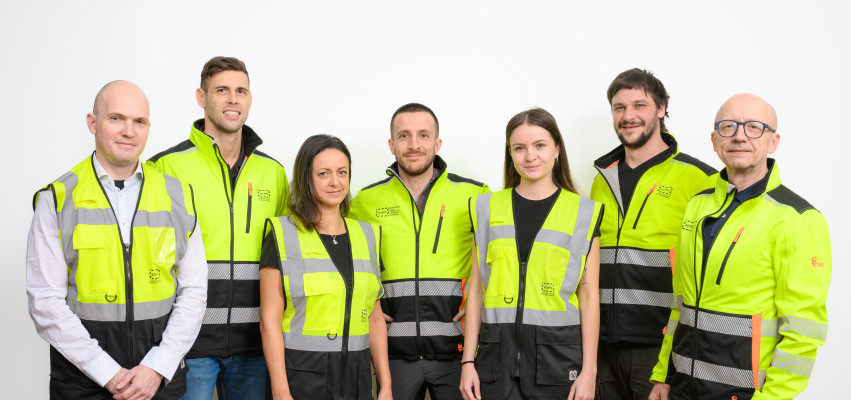
Workplace safety for a restaurant: the full picture
A restaurant kitchen is one of the densest workplaces you can run: open flames, hot oil, knives, steam, wet floors, chemicals and a lot of people moving fast in a small space. Add the dining room, the cellar and the staff turnover, and you have a full set of duties under both labour and public health law.
What you need from your first employee
- familiarisation on entry and before assignment to the workplace, repeated at least every three years (Section 7(1) and (5) of Act No. 124/2006 Coll.),
- a written risk assessment document and a list of personal protective equipment (Section 6(1)(c) and (d) of Act No. 124/2006 Coll.),
- occupational health service and work categorisation (Section 21(3) of Act No. 124/2006 Coll.),
- fire protection training before work starts and then at least every 24 months (Section 22 of Decree No. 121/2002 Coll.),
- fire protection documentation under Section 9(2) of Act No. 314/2001 Coll.,
- records of occupational accidents under Section 17 of Act No. 124/2006 Coll.
The kitchen
Burns, cuts and falls make up almost all kitchen accidents. The risk assessment should name the actual tasks: carrying hot pots, draining and filtering fryer oil, working with a slicer and a mincer, cleaning the extraction hood, moving crates in the cellar. Non-slip floors and footwear, cut-resistant gloves for the slicer, and a clear rule that a knife is never left in a sink of water cost nothing and prevent most of it.
Cooking oil and fat require a class F fire extinguisher. Grease deposited in the hood and ventilation ducts is flammable, so cleaning the extraction system and grease traps belongs in the operating procedures with an interval that matches how much you fry.
Hygiene and HACCP
A restaurant is a catering facility under Decree No. 533/2007 Coll. of the Slovak Ministry of Health. You need HACCP documentation, an operating manual and a sanitation plan. Everyone handling unpackaged food must meet the health and professional competence requirements under Sections 15 and 16 of Act No. 355/2007 Coll. The everyday term "health card" does not exist in the law; it refers to a certificate of health fitness issued by a physician.
Gas appliances, extraction and electrical equipment
Gas ranges, boilers and pressure equipment are dedicated technical equipment under Decree No. 508/2009 Coll.: group A and B equipment is subject to professional inspections and tests (Section 13) and to operation by a person holding the required certificate (Section 17). Fridges, freezers, combi steamers, dishwashers and extension leads are tested under STN 33 1630:2025, which replaced STN 33 1600 and STN 33 1610 on 1 May 2025, with parallel use allowed until 1 May 2027.
Fire protection and the dining room
The dining room is a space open to the public, so escape routes are the first thing any inspection looks at: free and marked escape routes under Government Regulation No. 387/2006 Coll., working emergency lighting, portable fire extinguishers in the quantity under Section 9 of Decree No. 347/2022 Coll. checked once a year, hydrants under Section 15 of Decree No. 699/2004 Coll., and preventive fire inspections within the intervals under Section 14 of Decree No. 121/2002 Coll. In rented premises the tenant performs these duties unless the lease says otherwise (Section 6(2) of Act No. 314/2001 Coll.).
What we take off your hands
Risk assessment, PPE list, HACCP documentation and operating manual, full fire protection documentation, OSH and fire training including casual staff, inspection intervals and representation during an inspection.
Ask for a quotation for your restaurant and tell us how many employees you have and whether you cook with gas.
-
How to avoid fines for OSH, fire protection and oc...
OSH fines up to €100,000, fire protection up to €16,596, occup...
-
Workplace safety for a hotel and guest house
What a hotel needs: evacuation plan and fire alarm instruction...
-

Workplace safety for a shop and retail
What a shop needs: training, risk assessment, manual handling...
-
Workplace safety for production and workshops
What a production hall needs: machine guarding, local operatin...